Collection and Masking the Data
Our first and foremost goal is to collect the data’s that is needed for the next step.
Data Collection
We started our path with collecting the data’s from different sources..
Our Mentors has reduced the work for us by collecting both
`Library-data`and`Exam-cell data `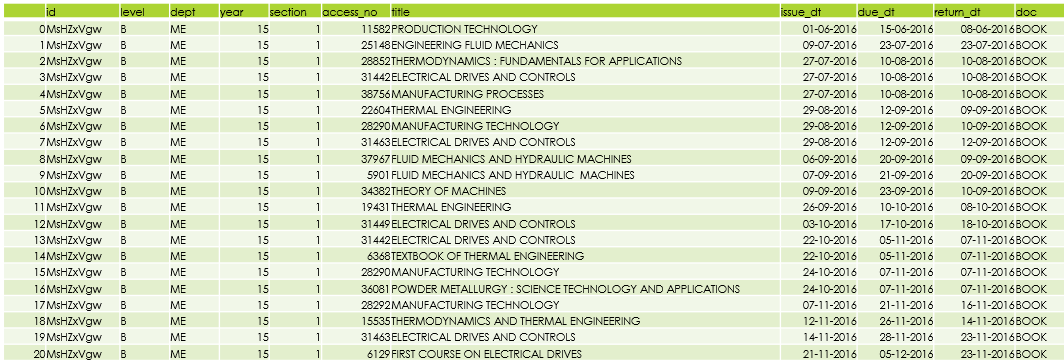
Sample Image of Library Transaction data…
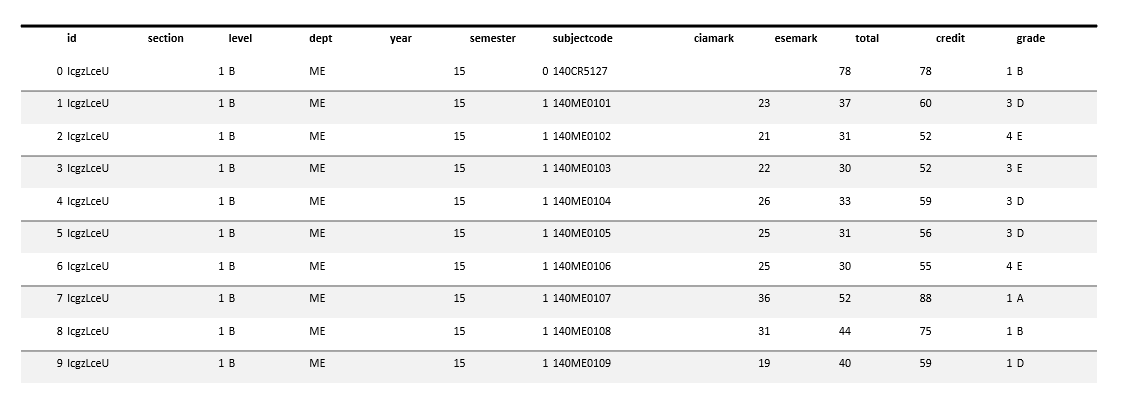
Sample Image of Exam-cell data…
Data Masking
After data collection process, we can’t use the sensitive information of student..
So our plan is to implement a function which can take the students
**Roll.No**and mask them with a unique id..We got both the data without
** Roll.No **column, where the sensitive information will not be revealed..Importing required libraries …
import numpy as np
import pandas as pd
from django.utils.crypto import get_random_string
Importing the data …
st_list = pd.read_excel('useridsalone-2.xlsx',sheet_name=2)
st_book_trans_lib = pd.read_excel('useridsalone-2.xlsx',sheet_name=1)
st_entry_lib = pd.read_excel('useridsalone-2.xlsx',sheet_name=0)
A code block of our function is given below:
def idmap(st_data,records):
     no_of_students = len(st_data['roll_no'])
     n = pd.Series(np.arange(0,no_of_students,step=1))
     n = n.map(str)
     st_data['id']=n.apply(lambda x: get_random_string(8))
     records.columns = ['roll_no']
     records['batch_no'] = records.roll_no.str[0:2]
     records['prog'] = records.roll_no.str[2]
     records['prog'] = list(map(lambda x : x.upper(),records.prog))
     records['dept'] = records.roll_no.str[3:5]
     records['dept'] = list(map(lambda x : x.upper(),records.dept))
     records['roll_no_num'] = records.roll_no.str[5:]
     records['roll_no']=records['batch_no'].map(str)+records['prog'].map(str)+records['dept'].map(str)+records['roll_no_num'].map(str)

     #filtering
     filt = (records['dept'] == 'ME') & (records['prog'] == 'B')
     records = records.loc[filt]
     df_name = pd.merge(records,st_data,how='right',on='roll_no')
     df_name.drop(columns=['roll_no','roll_no_num'],inplace=True)
     df_name.to_csv('.csv')


     # df.head()
     return df_name
In the above function we have accomplished masking the
`roll_no`with unique`id's`and further some`string operations`..